
Formulated by a pharmacist
Three supplements.
One capsule a day.
CoQ10 200 mg · Vitamin D3 5,000 IU · Vitamin K2 300 mcg
$89.99 for a 90-day supply · Free shipping
About $1.00 a day · $0.78 a day with the 4-pack
Shop nowOr subscribe and pay $79.99 every 3 months.
New here? Take 10% off your first bottle with code FIRST10.
Buying these three as separate bottles at the same doses costs about $127 to $375 for 90 days.


Mega Restore
About $1.00 a day · $0.78 a day with the 4-pack
One capsule. CoQ10, D3 and K2 at full study doses. 200 mg CoQ10 as ubiquinol, 5,000 IU vitamin D3, 300 mcg vitamin K2 as MK-7. Helps replenish CoQ10 depleted by age and certain drugs such as statins.* Supports heart and cellular energy, antioxidant defenses, bone health, and immune health.* 90 capsules, a 90-day supply.
No buzz. No crash. Just the right doses, every day. You will not feel this working, and you are not supposed to. It shows up in your lab work, not in how you feel by lunch.
Taking medication, especially a blood thinner, or using other vitamin D products? Read the safety information and speak with a qualified clinician before use.
Free U.S. shipping
Formulated by a pharmacist
Manufactured in the USA · cGMP
Full product details
One capsule. CoQ10, D3 and K2 at full study doses. Mega Restore combines 200 mg of CoQ10 as ubiquinol, 5,000 IU (125 mcg) of vitamin D3, and 300 mcg of vitamin K2 as MK-7 in a single daily capsule. These are the forms and the amounts that most combination products quietly cut, kept whole in one bottle. Each bottle contains 90 capsules, a 90-day supply at the suggested use of one capsule daily.
Four-bottle year supply: $279.96. Save $80 vs. four single bottles.
Per capsule
| Active ingredient | Form | Amount |
|---|---|---|
| Coenzyme Q10 | Ubiquinol (the ready-to-use form) | 200 mg |
| Vitamin D3 | Cholecalciferol | 125 mcg (5,000 IU) |
| Vitamin K2 | Menaquinone-7 (MK-7) | 300 mcg |
No proprietary blends. Every active is disclosed at its exact amount. Refer to the product label for the complete Supplement Facts panel and other ingredients.
What it does*
- Supports cellular energy production*
- Antioxidant support*
- Supports bone health and the body's normal use of calcium*
- Helps replenish CoQ10, which the body makes less of with age*
Why these forms
Ubiquinol is the form of CoQ10 your body can use right away. It is the form found in your blood. MK-7 is the long-acting form of vitamin K2, with a half-life measured in days rather than hours, which suits once-daily dosing. D3 (cholecalciferol) is the same form of vitamin D the skin produces from sunlight. Choosing these forms costs more per milligram than the common alternatives; we chose them anyway.
Suggested use
For adults, take one capsule once daily in the morning, with or without a meal, or as recommended by a qualified healthcare professional.
Please read before use
Consult your healthcare professional before use if you are pregnant, nursing, or taking any medication. This product provides 5,000 IU of vitamin D3 per capsule; account for vitamin D from all other supplements you take. Do not use if the safety seal is damaged or missing. Keep out of reach of children. Store at room temperature.
Manufactured in the USA in an FDA-registered food facility in Boca Raton, Florida, under applicable current Good Manufacturing Practice (cGMP) requirements. Each finished lot is tested and reviewed before release; a certificate of analysis is available for each production lot on request.
*These statements have not been evaluated by the Food and Drug Administration. This product is not intended to diagnose, treat, cure, or prevent any disease.
Suggested use & safety
For adults, take one capsule once daily in the morning, with or without a meal, or as recommended by a qualified healthcare professional.
Consult your physician before use if you are pregnant, nursing, taking medication, or have a medical condition. Vitamin K can interact with anticoagulants such as warfarin; if you take a blood thinner, speak with the clinician who manages your medications before use. Account for vitamin D from all other supplements. Keep out of reach of children.
Why these forms
Ubiquinol is the form of CoQ10 your body can use right away. It is the form found in your blood. MK-7 is the long-acting form of vitamin K2, with a half-life measured in days rather than hours. D3 is the same form your skin makes from sunlight. Each costs more per milligram than the common alternative; we chose them anyway. Read the full science.
Subscriptions & shipping
Subscribe and stop reordering. Quarterly: one bottle every 90 days for $79.99. Yearly: four bottles once a year for $249.96, $30 less than buying them outright, for something you're going to take every day anyway. We email you seven days before every charge; skip, pause, or cancel in one click from your account.
Free standard shipping within the United States; orders ship within 1–3 business days. Because supplements cannot be resold, all sales are final; damaged or defective items are replaced. See our refund policy.
Mega Restore
What 90 days costs
CoQ10 200 mg, vitamin D3 5,000 IU and vitamin K2 300 mcg, priced three ways.
New here? Take 10% off your first bottle with code FIRST10. Free shipping on every order.
Separate-bottle prices are from real listings we checked in August 2026. See the full price comparison.
What it does
What one capsule of Mega Restore does, in plain terms.*
These are the statements printed on the bottle, plus what the research shows about the nutrients in every capsule.
Helps replenish CoQ10 depleted by age and certain drugs such as statins*
Your body makes its own CoQ10, and tissue levels peak around age twenty and decline from there. Some medications lower it further. Mega Restore puts back the form your body uses, at the dose the human studies used.*
Supports heart and cellular energy*
CoQ10 is part of the machinery every cell uses to make energy, and heart muscle uses more of it than almost any other tissue.*
Helps keep calcium in bones, not arteries*
Vitamin D helps you absorb calcium. Vitamin K2 activates the proteins that direct that calcium into bone and away from artery walls. In a 3-year study, healthy women taking MK-7 had more flexible arteries than women on placebo. Supports bone health and the body's normal use of calcium.*
Antioxidant support*
Ubiquinol is a fat-soluble antioxidant that works inside cell membranes, where water-soluble antioxidants cannot reach.*
Supports a healthy inflammatory response*
In a review of 17 clinical trials, CoQ10 lowered three common blood markers of inflammation: CRP, IL-6 and TNF-alpha. Every capsule gives you 200 mg, every day.*
Helps your muscles recover from hard training*
In studies of athletes, CoQ10 lowered blood markers of muscle strain and oxidative stress after hard exercise, including a 50 km mountain run. Training for a race or lifting hard? One capsule a day fits right in.*
Supports energy in your muscles*
In lab studies, vitamin K2 helped the mitochondria in muscle cells work better by turning on SIRT1, a key cell energy switch. In human trials, MK-7 improved how well the body uses insulin. Pair that with CoQ10 and you have two nutrients working on your cells' energy in one capsule.*
Supports immune health and vitality*
Vitamin D receptors sit on the cells of the immune system, and vitamin D status falls with age, indoor life, and northern winters. Supports normal immune function.*
Full doses, once a day*
200 mg ubiquinol, 5,000 IU D3, and 300 mcg MK-7 would normally mean three bottles and up to six capsules. Here it is one capsule each morning.
*These statements have not been evaluated by the Food and Drug Administration. This product is not intended to diagnose, treat, cure, or prevent any disease. Consult your physician before use if you are pregnant, nursing, taking medication, or have a medical condition.
See the evidence behind each statementWhere the money goes
Two places a formulator can save money. We didn't take either one.
The front of a bottle tells you which nutrients are in it. The fine print tells you which version, and the two versions are not interchangeable.
Coenzyme Q10: ubiquinone vs. ubiquinol
| Ubiquinone, the common form | Ubiquinol, what we use | |
|---|---|---|
| What your body has to do with it | Change it into ubiquinol before it can use it | Nothing; it is the form already in your blood |
| Plasma CoQ10 after 4 weeks at 200 mg/day | 0.9 → 2.5 µg/mL | 0.9 → 4.3 µg/mL |
| Cost to the formulator | Roughly a third as much | Materially more per milligram |
Vitamin K2: MK-4 vs. MK-7
| MK-4, the cheap form | MK-7, what we use | |
|---|---|---|
| Half-life in the blood | About 1 hour | About 3 days |
| Detectable in serum at nutritional doses? | Not measurably, in the published pharmacokinetic work | Yes, still elevated 48 hours after a dose |
| Suits once-daily dosing? | Peaks and clears within the same day | Builds to a steady level and holds it |
More than twice the rise, at our exact dose. In a head-to-head study, adults took 200 mg a day of each form. Blood CoQ10 rose by 1.6 µg/mL on ubiquinone and by 3.4 µg/mL on ubiquinol. That is why every capsule of Mega Restore uses ubiquinol, even though it costs us more. Other trials have also found that both forms raise CoQ10 levels; the full list is on our research page.
The problem we set out to solve
To match this one label, most people are buying three bottles.
Ubiquinol is usually sold at 100 mg, so a 200 mg dose is two capsules. MK-7 is usually sold at 100 mcg, so 300 mcg is three capsules. Add the D3 and you are at six capsules a day, three reorder dates, and three chances to run out.
| Nutrient at target dose | Common bottle strength | Capsules per day | Typical cost per day |
|---|---|---|---|
| Ubiquinol 200 mg | 100 mg capsule | 2 | $0.90 |
| Vitamin K2 MK-7 300 mcg | 100 mcg capsule | 3 | $0.47 |
| Vitamin D3 5,000 IU | 5,000 IU capsule | 1 | $0.05 |
| A well-known "D3 + K2 + CoQ10" formula | 4,000 IU D3 · ~120 mcg K2 · 40 mg ubiquinol | 1 | $2.53 |
| Mega Restore, all three | One capsule, full doses | 1 | $1.00 |
Comparison prices are the median of mainstream retail listings surveyed in August 2026 across Vitacost, iHerb, Walmart and brand direct-to-consumer sites. Prices change; the capsule counts don't. Mega Restore cost per day is based on the one-time price of one bottle. The combination formula above is listed at $76 per bottle and contains 40 mg of ubiquinol and about 120 mcg of MK-7 per capsule.
Built for a specific person, useful to a much wider one.
From the exam room

I made this for my own patients.
I am a pharmacist clinician. I see patients, order labs and prescribe, and I own and run Evergreen Longevity & Functional Medicine, a functional medicine practice serving Washington and Idaho. I am board-certified in anti-aging and regenerative medicine and in advanced hormone therapy, and certified in functional medicine. I am trained in heart attack and stroke prevention, and it is a large part of my daily practice.
Ubiquinol, vitamin D3 and vitamin K2 are foundational: three nutrients I want almost every adult I care for to have at the right doses. The trouble was getting there. Three bottles and up to six capsules a day is a lot to ask of anyone, and most people quietly stopped within a month. So I put the right ingredients, at the doses the studies used, into one capsule a day, so my patients get the benefit without adding much to their pill burden.
I publish every source I relied on, including the studies that complicate my case. If you take prescription medication, ask the clinician who manages it before you start.
Questions
The things people ask before they buy.
Is 5,000 IU of vitamin D too much?
It is a deliberate, higher-end dose, and you should know the context. The National Academy of Medicine sets an upper intake level of 4,000 IU per day for adults, so 5,000 IU sits above it. Doses in this range have a long track record of use, and toxicity is linked to far higher intakes over long periods. It deserves a conversation with your doctor and a periodic blood test, not a shrug. If you already take a separate vitamin D product, do not stack them.
Why ubiquinol instead of the cheaper CoQ10?
CoQ10 comes in two forms. The common one, ubiquinone, has to be changed by your body before it can be used. Ubiquinol is the form your body can use right away, and the form found in your blood. In a published comparison at our 200 mg dose, four weeks of ubiquinol raised blood CoQ10 more than four weeks of ubiquinone in the same people. That study was small, and another found no significant difference in older adults. We think it is the better choice; we will not pretend the literature is unanimous.
I take a statin. What should I know?
Speak with your pharmacist or clinician before adding any supplement. A 2015 systematic review of placebo-controlled trials reported lower blood CoQ10 after statin therapy and called for more trials. That research does not establish that Mega Restore restores a deficiency, treats or prevents medication side effects, or is right for every person who uses a statin. Do not start, stop, or change prescribed medication based on this page.
How long before I notice anything?
This is a foundational supplement, not something you feel in a week. Blood CoQ10 rises over two to four weeks. MK-7 reaches a steady level in about two weeks. Vitamin D status shifts over two to three months. Some people notice everyday energy in the first month and some notice nothing at all. Give it the full ninety days.
Can I take it with a blood thinner or my multivitamin?
Blood thinner: do not decide this from a website. Vitamin K directly affects how warfarin and similar drugs work. Speak with the clinician who manages your medication before use. Newer types of blood thinners work differently, and vitamin K does not change how they work, but still check with your prescriber. Multivitamin: usually yes, but check the vitamin D. Many contain 1,000 to 2,000 IU, and you do not want to add that to 5,000 IU without knowing.
Why is one bottle ninety capsules instead of thirty?
Because the dose is one capsule a day, so ninety capsules is ninety days. A quarterly bottle means four decisions a year instead of twelve, and a lot less trash.
Do I have to be on a medication to benefit from this?
No. The reasons to take these three nutrients apply to healthy adults with no prescriptions at all. If you do take prescription medication, read the safety note and talk with your physician, particularly about blood thinners.
When should I take it?
Once daily in the morning, with or without a meal. Some people find CoQ10 mildly activating, so morning rather than bedtime.
Is it tested?
Each finished lot is tested and reviewed by the manufacturer's quality team before release, and a certificate of analysis is issued for it. Email us with the lot number on your bottle and we will send it.
Can I return it?
Supplements cannot be restocked or resold once they leave our control, so all sales are final. If your bottle arrives damaged, with a broken seal, or otherwise defective, email us within 48 hours of delivery with your order number and a photo and we will replace it at no charge. Orders that have not shipped yet can be cancelled and refunded in full.
*These statements have not been evaluated by the Food and Drug Administration. This product is not intended to diagnose, treat, cure, or prevent any disease.
Before you buy
One thing we won't bury in the footer
Do not take this product if you take warfarin (Coumadin), acenocoumarol, phenprocoumon, or any other vitamin K antagonist blood thinner without first speaking with the clinician who manages your anticoagulation. Vitamin K2 directly opposes how those medications work and can destabilize your anticoagulation at doses far below the 300 mcg in this capsule. This is a safety matter, not boilerplate. Newer types of blood thinners work differently, and vitamin K does not change how they work; if you take any blood thinner, still check with your prescriber before adding a supplement.
If you take any prescription medication, are pregnant or nursing, have kidney disease, hyperparathyroidism, sarcoidosis, or a history of kidney stones, talk to your physician before starting. This product provides 5,000 IU of vitamin D3 per capsule, which is above the 4,000 IU daily upper intake level set by the National Academy of Medicine for adults; periodic checking of your vitamin D and calcium levels is sensible with long-term use, and you should not combine it with other vitamin D products without accounting for the total.
Suggested use: For adults, take one capsule once daily in the morning, with or without a meal, or as recommended by a qualified healthcare professional. Do not use if the safety seal is damaged or missing. Keep out of reach of children. Store at room temperature. Do not start, stop, or change prescribed medication based on this page.
The full label
See the full label before you decide.
Review the Supplement Facts panel, suggested use, caution statement, and storage information. If anything is unclear, contact us at info@functionalformulas.health before ordering.

Tap the label to open it at full size. The label on the bottle you receive governs; if this image and your bottle ever differ, email us and we will send the current artwork.
The right ingredients, at the right doses
Ubiquinol 200 mg
Vitamin D3 5,000 IU
Vitamin K2 MK-7 300 mcg
One capsule, not a fistful
Four bottles a year, not twelve
Manufactured in the USA · FDA-registered facility
No proprietary blends
Per capsule
Full doses. Nothing dosed down to save money.
Refer to the product label for the complete Supplement Facts panel and other ingredients.

Why vitamin D and K2 belong togetherthe mechanism, in detail
Why the pairing matters
Vitamin D creates the demand. Vitamin K2 is what meets it.
This is the single best reason these two belong in the same capsule, and it is a point of real physiology, not a marketing slogan.
Vitamin D does two things at once. It makes your gut far better at absorbing calcium, roughly the difference between 10–15% of dietary calcium absorbed without adequate vitamin D and 30–40% with it. And, separately, it increases how much of certain vitamin K-dependent proteins your body produces, osteocalcin among them.
Those proteins arrive from the factory switched off. They only become able to bind calcium after an enzyme adds calcium-binding sites to them, and that enzyme cannot work without vitamin K. So more vitamin D means more of these proteins waiting to be activated, and vitamin K is the thing that activates them. That is why the two nutrients are best thought of as a pair rather than as two separate purchases.
Being straight with you about the evidence. That the demand exists, and that supplemental K2 measurably raises the activated fraction of these proteins, is well established in human trials. The longer-term clinical consequences of pairing them are still being studied, and some trials have been negative. We formulate for the mechanism and we'll let the outcome research keep maturing. This product isn't intended to diagnose, treat, cure, or prevent any disease.
What one capsule is doing in the bodyfive roles, in order
In the body
What one capsule a day is actually doing.
Not a list of promises. A description of the roles these three nutrients play, in the order the body uses them.
Energy production, at the cellular level
Every cell that does work runs on ATP, and ATP is made in the mitochondria by passing electrons down a chain of protein complexes. CoQ10 is the mobile carrier that moves those electrons between complexes. It isn't a stimulant and it doesn't act like caffeine; it's a component of the machinery. Supports cellular energy production.*
Antioxidant protection inside cell membranes
Most dietary antioxidants are water-soluble and work in the fluid inside and around cells. Ubiquinol is fat-soluble, which means it works where water-soluble antioxidants can't reach: inside the lipid membranes of the cell and the mitochondria themselves. Provides antioxidant support.*
Calcium, absorbed and then directed
Vitamin D makes calcium absorption efficient. Vitamin K2 activates the proteins that put calcium where the body intends it to go; osteocalcin binds it into the bone matrix. Supports bone health and the body's normal use of calcium.*
Normal immune function
Vitamin D receptors sit on T cells, B cells, monocytes and dendritic cells, and the active form of vitamin D induces cathelicidin, an antimicrobial peptide made by immune cells. This is one of the better-mapped non-skeletal roles of the vitamin. Supports normal immune function.*
Replacing what naturally declines
CoQ10 in human heart muscle peaks around age twenty and is roughly half as concentrated by the eighth decade. Vitamin D status falls with less sun exposure, more indoor time, and age. Neither of those is a disease; it's ordinary human aging, and it's the clearest argument for putting these back deliberately. Helps replenish CoQ10 and maintain healthy vitamin D status.*
*These statements have not been evaluated by the Food and Drug Administration. This product is not intended to diagnose, treat, cure, or prevent any disease.
Manufactured in the USA. Tested before it's made. Traceable after it's sold.


What happens over ninety days
A foundational supplement, not something you feel in a week.
MK-7 reaches a steady level
With a half-life of roughly three days, vitamin K2 as MK-7 builds to a stable blood level over about two weeks of once-daily dosing.
Plasma CoQ10 rises
Blood levels of CoQ10 climb over two to four weeks. In a published comparison at our 200 mg dose, ubiquinol raised plasma CoQ10 more than the conventional form.
Vitamin D reaches steady state
25-hydroxyvitamin D rises gradually and levels off after about three months of consistent daily dosing. That is a sensible point to check a level with your clinician and confirm the dose is right for you.*


What ninety days costs, seven waysthe full price comparison
The math
What ninety days of these three nutrients costs, seven different ways.
We surveyed real listings in August 2026 and priced each nutrient at the dose that's actually in this capsule.
| Ninety days of ubiquinol 200 mg + D3 5,000 IU + MK-7 300 mcg | What you buy | Cost |
|---|---|---|
| Practitioner brands, bought separately | 3 bottles · up to 6 capsules/day | $374.94 |
| Existing 3-in-1 combination product | Well-known brand · 40 mg ubiquinol · ~120 mcg K2 | $227.99 |
| Mid-market brands, bought separately | 3 bottles · up to 6 capsules/day | $127.44 |
| Mega Restore, one bottle | 1 bottle · 1 capsule/day · $1.00/day | $89.99 |
| Mega Restore, quarterly subscription | Delivered every 90 days · $0.89/day | $79.99 |
| Mega Restore, four-bottle year supply | One order · $279.96 · $0.78/day | $69.99 |
| Mega Restore, yearly subscription (four bottles) | One decision a year · $249.96/yr · $0.68/day | $62.49 |
The combination product row contains lower amounts of ubiquinol and K2 than the other rows. All other rows deliver the same doses for ninety days. The difference is the form, the dose, the number of capsules, and how many reorder dates you have to remember.
Against the mid-market basket, a single bottle saves about $37 per quarter, roughly $150 a year. On the quarterly subscription that gap is about $190 a year; on the four-bottle supply about $230; on the yearly subscription about $260.
The yearly subscription exists for one reason. If this is something you are going to take every day anyway, there is no good reason to think about it twelve times a year, or even four. Four bottles arrive once a year, you never run out, and it costs $30 less than buying the same four bottles outright. We email you seven days before each charge, and you can skip or cancel from your account.
The one row we can't beat on price alone is the deep-discount commodity basket, which lands near $86 for the same ninety days. What it doesn't give you is one capsule instead of six, one company standing behind all three actives, or a certificate of analysis you can request.
Where the cost is. Vitamin D3 costs a few cents a day at any dose. Almost all of the cost in this category is in the ubiquinol, and next in the MK-7.
Selected references18 sources
Selected references
Where the statements on this page come from.
We cite what we relied on, including the studies that complicate our own case. The full list, with links, is on our Research & References page.
- Sood B, et al. Coenzyme Q10. StatPearls, 2024.
- Wang Y, Lilienfeldt N, Hekimi S. Physiological Reviews. 2024;104(4):1533–1610.
- Langsjoen PH, Langsjoen AM. Clinical Pharmacology in Drug Development. 2014;3(1):13–17.
- Zhang Y, et al. Food & Function. 2018;9(11):5653–5659.
- Pravst I, et al. Nutrients. 2020;12(3):784.
- D'Adamo CR, et al. Journal of Nutrition and Metabolism. 2026;5589963.
- Kalén A, Appelkvist EL, Dallner G. Lipids. 1989;24(7):579–584.
- Moreno-Fernández J, et al. Antioxidants. 2023;12(6):1193.
- Banach M, et al. Pharmacological Research. 2015;99:329–336.
- Fan L, et al. Pharmacological Research. 2017;119:128–136.
- Qu H, et al. Complementary Therapies in Clinical Practice. 2025;60:102001.
- Díaz-Castro J, et al. European Journal of Nutrition. 2012;51(7):791–799.
- Hathcock JN, Shao A. Regulatory Toxicology and Pharmacology. 2006;45(3):282–288.
- Schurgers LJ, et al. Blood. 2007;109(8):3279–3283.
- Sato T, Schurgers LJ, Uenishi K. Nutrition Journal. 2012;11:93.
- Theuwissen E, et al. British Journal of Nutrition. 2012;108(9):1652–1657.
- Theuwissen E, et al. Thrombosis and Haemostasis. 2013.
- Knapen MHJ, et al. Thrombosis and Haemostasis. 2015;113(5):1135–1144.
- Su X, et al. Antioxidants & Redox Signaling. 2021;34(2):99–117.
- Nikpayam O, et al. Prostaglandins & Other Lipid Mediators. 2025;177:106970.
- Du F, et al. British Journal of Nutrition. 2023;130(11):1885–1897.
- Holick MF. New England Journal of Medicine. 2007;357(3):266–281.
- Liu PT, et al. Science. 2006;311(5768):1770–1773.
- Gallagher JC, et al. Journal of Clinical Endocrinology & Metabolism. 2012;97(10):3550–3556.
- Tripkovic L, et al. American Journal of Clinical Nutrition. 2012;95(6):1357–1364.
- Institute of Medicine. Dietary Reference Intakes for Calcium and Vitamin D. 2011.
These references concern nutrient biology and published research on individual ingredients. They do not constitute medical advice, product-level clinical proof, or FDA evaluation of Mega Restore. *These statements have not been evaluated by the Food and Drug Administration. This product is not intended to diagnose, treat, cure, or prevent any disease.
The ordering process was quick and easy, and it was delivered quickly. My doctor prescribed me a statin and said I needed a quality CoQ10, and recommended this product as an all in one with great value. This supplement has three different things I need and take regularly, so this reduced me from taking three different pills down to one. Helping pair that down is a huge plus.
I don’t think this supplement is an instant “feel different” type of supplement, it was explained to me that regular usage will have long term health benefits. Would highly recommend.
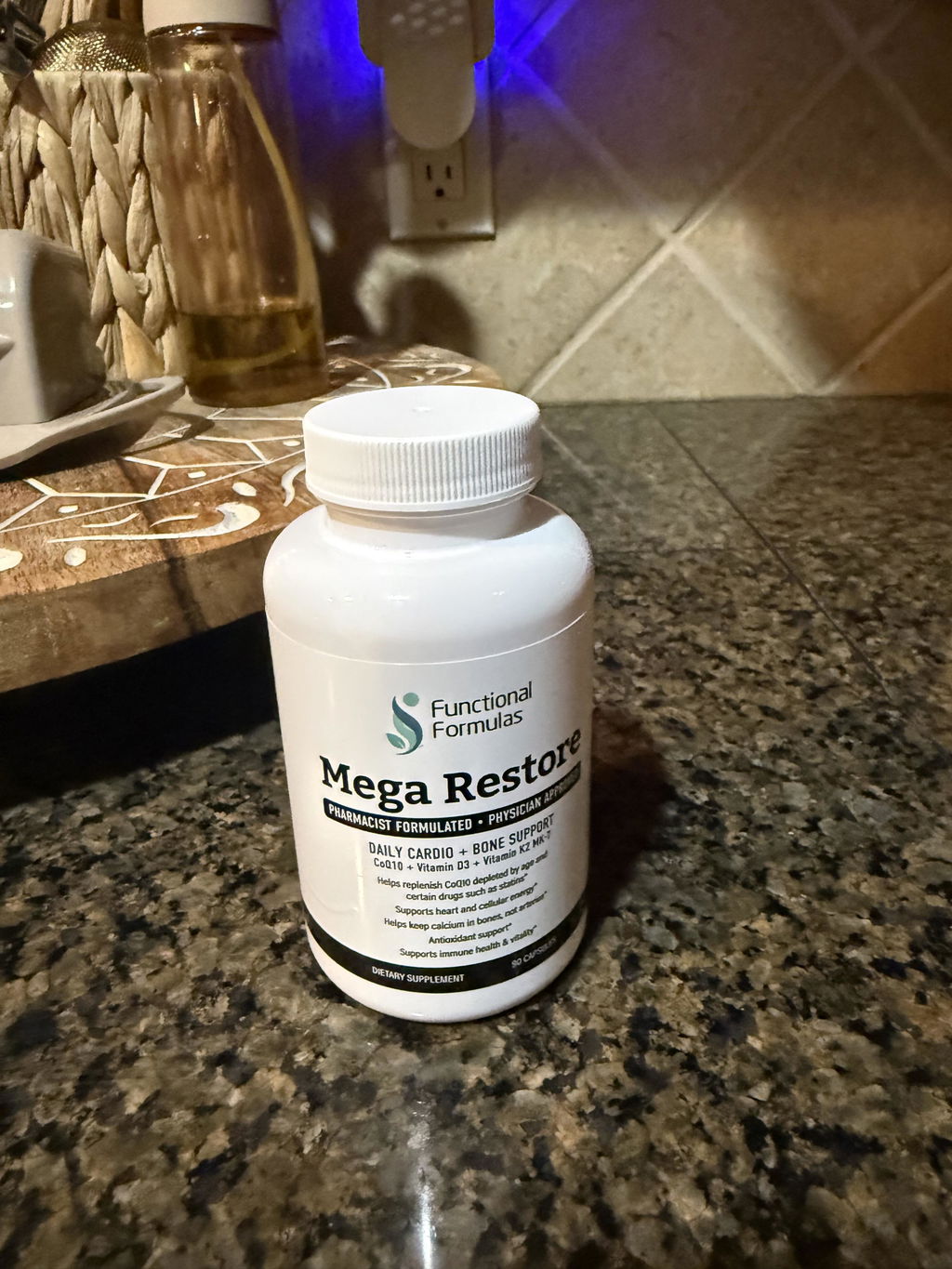
I really love this combination at exactly the right doses to support mitochondria and treat inflammation. I like only taking one pill instead of multiple pills every day. I recommend this to my patients as well.
I’ve been really impressed with Mega Restore. I’ve noticed a meaningful difference in how I feel since adding it to my daily routine, especially in my overall energy and sense of well-being. Definitely one I plan to keep in my routine.
Ordering was simple and it arrived fast, well-packed. I've been taking it daily and it’s great all 3 come in one capsule, so it's one less bottle on the counter. What I notice most is steady energy through the afternoon without that wired feeling. No aftertaste, no stomach issues, easy to swallow. Five stars, already reordering.